Week 36+37 - Reflective Journal - GAM705

 We are now onto our major project, and final module. The year is coming to an end, and my aim is now to create work to add to my portfolio that I'm proud of.

Currently, I know my plan is to focus on character design, and potentially to back up my work with discussions on story-telling/narrative in character design, as well as bias in character design.

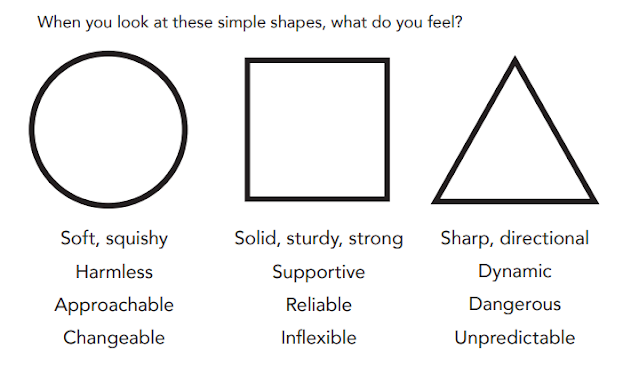
There are some basic elements in character design that are meant to tell an audience a lot about a character without saying it outright, a common one is "shape language":
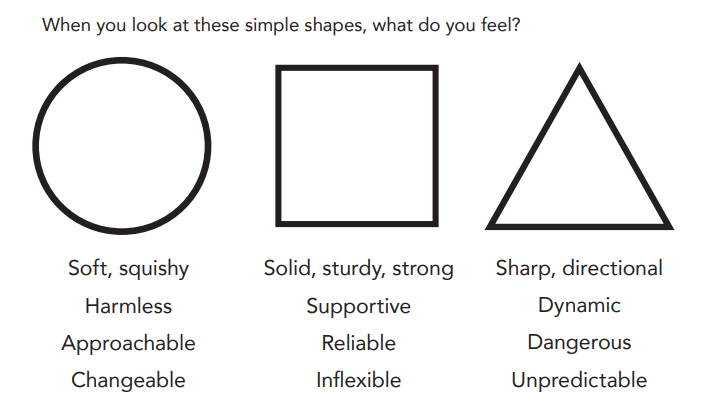
Fig. 1: WaltDisney.Org, 2020. Shape Language

Shape language is often strongly utilised in animation, where shapes and character designs are exaggerated for readability. Combining these shapes can also create different ideas of  how a character is or behaves. A character like Mr. Incredible from The Incredibles (2004) is mostly square in shape, to show his strength, but also has rounded features to suggest friendliness. This post by Keenan Acebedo shows how a combination of shapes can be used to create a diverse line-up of characters.

In animations aimed at an older audience, shape language is often still used but in a subtler way. For example, Vi (fig. 2) in Arcane (2022) has squared shoulders and a rounded face, but also sharp shapes in her hair - her design suggests she is a protagonist, but not necessarily friendly. 

Fig. 2: Theuillon, 2022. ARCANE - Vi

At the same time, designs can be used to show aspects of a character that may change in the narrative of the media they're in. To use Arcane as an example again, the character Caitlyn (fig. 3) is training to become an enforcer; her uniform is clean, symmetrical, and orderly, suggesting she is someone who would want to maintain structure and law. In the show, Caitlyn becomes rebellious, as she's put in a position of choosing between her personal feelings of what's right, and what she's been raised to believe in and stand for. 

Fig. 3: Theuillon, 2022. ARCANE - Caitlyn

In designs for games with realistic art styles, or live-action films, much of the narrative in design is put into the clothing. Vi's outfit in fig. 2 is mostly asymmetrical, except for her shirt, which has the sleeves ripped off, suggesting it's secondhand or stolen. Vi's design against Caitlyn indicate differences in the characters' upbringings and social standing. 

Fig. 4: Reeves, 2016. Corvo Attano, Dishonored 2 (2016)

In Dishonored 2 (2016), the design for Corvo Attano features asymmetry, but also reflects rank and class. This is also reflected in the design for Emily Kaldwin (fig. 5), Corvo's daughter and Empress of the Isles. Their clothing is clearly tailored but built with purpose. Gold accents and use of deep blues and purple highlight their social ranking, but features like belts for carrying weapons show they're capable of fighting. 

Fig. 5: Bishop, 2016. Emily Kaldwin, Dishonored 2 (2016)

Asymmetry also draws focus and interest towards a character, as usually generic background characters and NPCs have plainer designs that can be repeated, and clearly indicate who the character is without distraction. This is often seen in guard and citizen NPCs whom the player doesn't need to interact with (fig. 6). A character who is part of the guard, but is also part of the story, may have changes to the standard uniform to make them stand out and show more importance, such as removal of a helmet or mask, or a change in uniform colour, e.g. High Overseer Campbell in Dishonored (2012) wears a red uniform to indicate his higher rank, and no helmet (fig. 7). 

Fig. 6: Buliarca, 2012. Overseer, Dishonored (2012)

Fig. 7: Dishonored Fandom Wiki. High Overseer Campbell

In this post by Magdalina Dianova on "How to design a compelling character that tells a story", she goes into how to show the kind of person a character is through their design:

"The very first step in my process is to come up with an idea about my character’s personality and think about who they are. All I need is a keyword - something to begin with. The first one that pops in my mind is ‘antisocial’. From there I start asking basic questions - Why is my character antisocial, how does that affect their life, how do they perceive the world?"

She then builds an inspiration moodboard, using images of real people and film characters that match the personality of the character she wants to create. This is followed by exploration sketches and a final rough drawing of the design. Using this method, as I have done, as well as some world building to compliment my work, I plan to begin designing a character next week.

I've been writing notes of ideas, and narrowing down what I'd like to work on. I'm looking at games I like, such as Dishonored (2012), BioShock (2007), and Bloodborne (2014), to draw inspiration and art style.


References:

DIANOVA, Magdalina. 2019. 'How to design a compelling character that tells a story' [online] 3DTotal. Available at: https://3dtotal.com/tutorials/t/how-to-design-a-compelling-character-that-tells-a-story#article-introduction [Accessed on: 06/06/2023]

Images: 

Figure 1. WaltDisney.org. 2020. Tips & Techniques: Shape Language. waltdisney.org/education-resources [online]. Available at: https://www.waltdisney.org/sites/default/files/2020-04/T%26T_ShapeLang_v9.pdf [Accessed on: 02/06/2023]

Figure 2. THEUILLON, Candice. 2022. ARCANE - Vi. ArtStation [online]. Available at: https://www.artstation.com/artwork/b505vm [Accessed on: 02/06/2023]

Figure 3. THEUILLON, Candice. 2022. ARCANE - Caitlyn. ArtStation [online]. Available at: https://candicetheuillon.artstation.com/projects/aGy4zz [Accessed on: 02/06/2023]

Figure 4. REEVES, Ben. 2016. Corvo Attano, Dishonored 2 (2016). Gameinformer [online]. Available at: https://www.gameinformer.com/b/features/archive/2016/05/11/get-reacquainted-with-corvo-attano-from-dishonored-2.aspx [Accessed on: 05/06/2023]

Figure 5. BISHOP, Sam. 2016. Emily Kaldwin, Dishonored 2 (2016). GameReactor [online]. Available at: https://www.gamereactor.eu/take-a-look-at-the-fashion-of-dishonored-2/ [Accessed on: 05/06/2023]

Figure 6. BULIARCA, Christian-Marius. 2012. Overseer, Dishonored (2012). ArtStation [online]. Available at: https://www.artstation.com/artwork/QVVll [Accessed on: 06/06/2023]

Figure 7. Dishonored Fandom Wiki. High Overseer Campbell. Dishonored Fandom Wiki [online]. Available at: https://dishonored.fandom.com/wiki/Campbell%27s_Lamentation [Accessed on: 06/06/2023]

GAM703 Submission


Game Trailer

Personal Vlog

GAM703 - Final Character Designs

Dominion of Warclaws
Tailpit Tribe
Razorboar Clan
Lynandria Cartel
Longhorn Pack
Ent-Wives

Weeks 31-34 - Reflective Journal

I first started working on the tree people, named the Ent-Wives - a female group seeking their lost male counterparts.

The feedback on my initial sketches (fig. 1) was that they didn't both read as "female", so I took a more stereotypically feminine approach to my design.

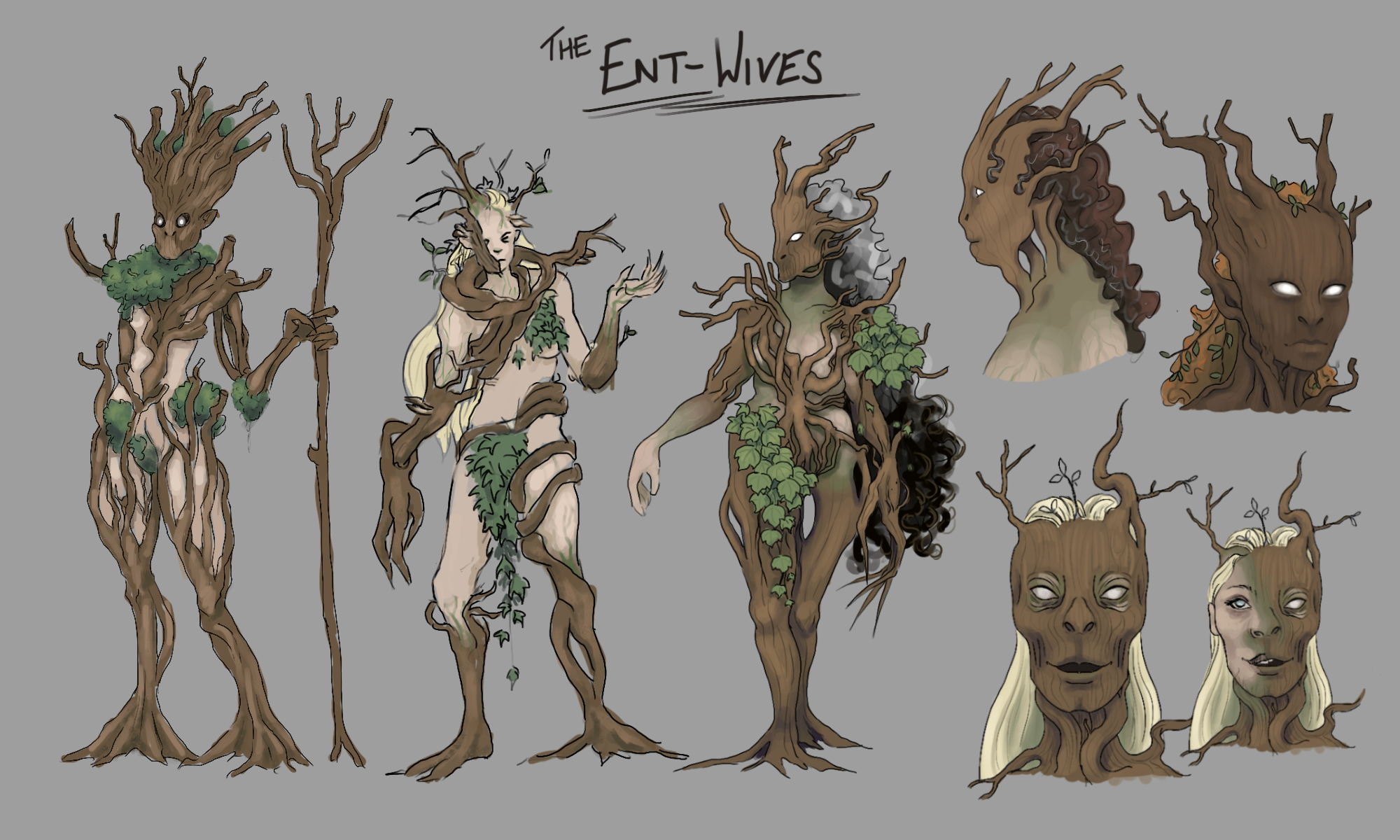
I wanted to experiment with the idea of the Ent-Wives bodies gradually being overtaken by plants, with parts of their human body being left before being entirely consumed.

Fig. 1: Spence, 2023. Initial Sketches.
Fig. 2: Spence, 2023. The Ent-Wives

Myself and my group all agreed that my third design was the strongest, and was the one that would be taken forward to be made into a final game piece.

Next, I worked on the fox people, the Lynandia Cartel - a desert dwelling group of vain, fox-like traders.

Fig. 3: Spence, 2023. The Lynandria Cartel

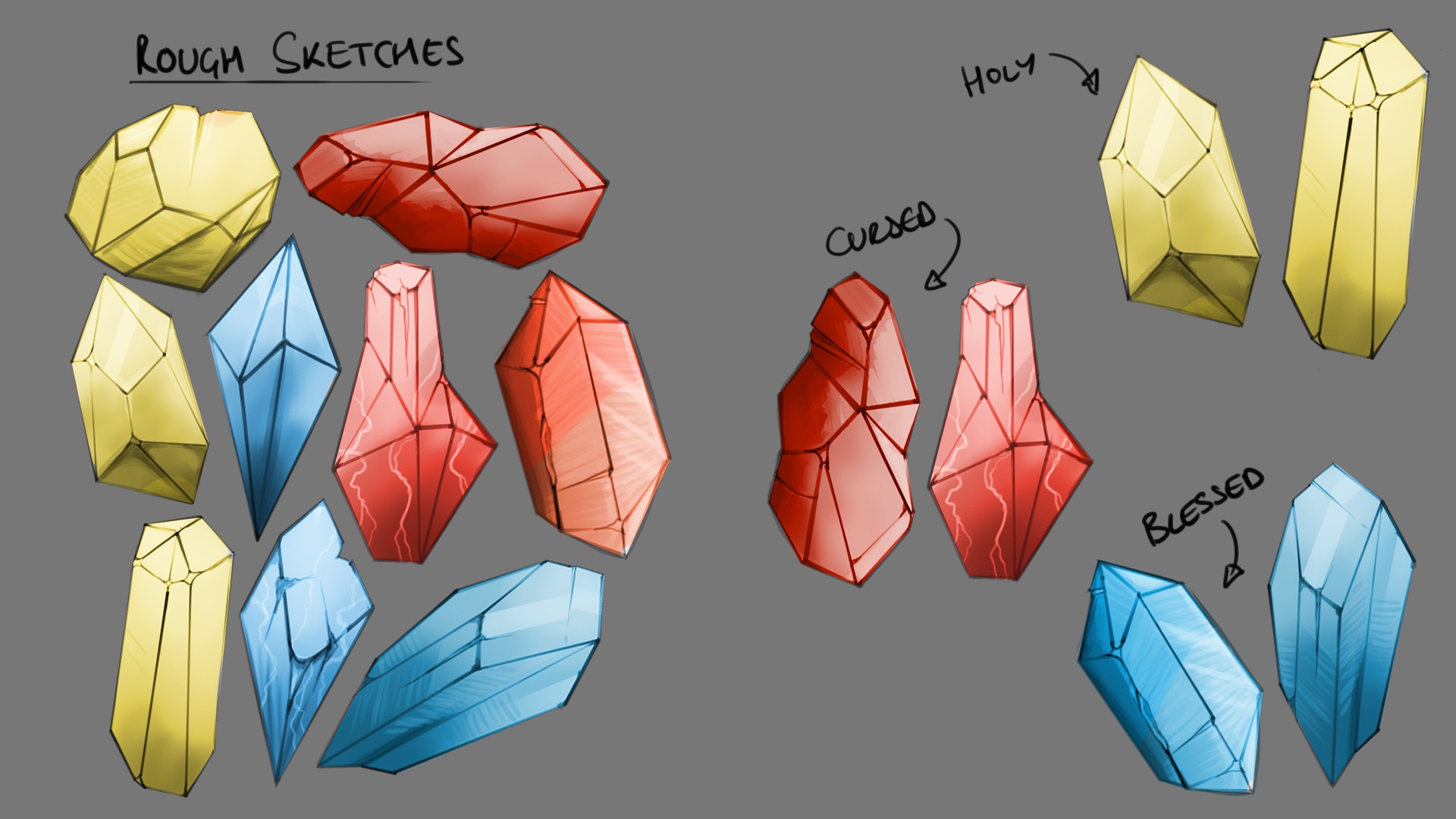
Fig. 4: Spence, 2023. Artifact Sketches

Various other pieces I worked on were the artifacts (fig. 4). The game was originally going to feature three types of artifact - blessed (fig. 5), cursed (fig. 6), and holy (fig. 7) - which each behaved differently in game. Unfortunately, due to time restraints with balancing, the designs for the cursed and holy artifact were put to one side, and the team focused on the blessed artifact.

Fig. 5: Spence, 2023. Blessed Artifact

Fig. 6: Spence, 2023. Cursed Artifact
Fig. 7: Spence, 2023. Holy Artifact

I also began some rough ideas for a background for the app, specifically art for when orcs obtained the artifact.

Fig. 8: Spence, 2023. Orc Background (1)
Fig. 9: Spence, 2023. Orc Background (2)

As it came into question whether or not we'd be using backgrounds at all, I began focusing on the Razorboar Clan - a group in a savanna type area, with a culture focused on farming and protecting their lands. I based their weapons on the ngulu from the Congo, as it reminded me of a scythe, making their weapons double as an agricultural tool.

Fig. 10: Spence, 2023. The Razorboar Clan

I also decided to try photobashing for the first time for this project. Photobashing is a technique that involves blending photographs and painting together to create a final piece. It's a good way to build noise and texture in an image, as well as make concepts quickly. As this had to be a more finalised piece, I spent about three days working on it to create the background for Artifacts of Linmarch. This image is present in the app, and would be present on a box the game would come in.

Fig. 11: Spence, 2023. Artifacts of Linmarch Photobash

Due to unforeseen circumstances arising with the other 2D artist in the group, I was tasked with completing the other faction designs - the fauns of the Longhorn Pack, the snake-folk of the Tailpit Tribe, and the bird people of the Dominion of Warclaws.

Fig. 12: Spence, 2023. Longhorn Face Sketches
Fig. 13: Spence, 2023. Longhorn Clothing Sketches

To help with the sudden increase in workload, a member of another team, James Thompson, created some concepts for the Warclaws and Tailpit Tribe (fig. 14 + 15). 

Fig. 14: Thompson, 2023. James' Warclaw Concepts
Fig. 15: Thompson, 2023. James' Tailpit Concepts
Fig. 16: Spence, 2023. Final Designs


References:

Images:

Figure 1. SPENCE, Nel. 2023. Initial Sketches. Private Collection: Nel Spence

Figure 2. SPENCE, Nel. 2023. The Ent-WivesPrivate Collection: Nel Spence

Figure 3. SPENCE, Nel. 2023.  The Lynandria CartelPrivate Collection: Nel Spence

Figure 4. SPENCE, Nel. 2023. Artifact SketchesPrivate Collection: Nel Spence

Figure 5. SPENCE, Nel. 2023. Blesses ArtifactPrivate Collection: Nel Spence

Figure 6. SPENCE, Nel. 2023. Cursed ArtifactPrivate Collection: Nel Spence

Figure 7. SPENCE, Nel. 2023. Holy ArtifactPrivate Collection: Nel Spence

Figure 8. SPENCE, Nel. 2023. Orc Background (1). Private Collection: Nel Spence

Figure 9. SPENCE, Nel. 2023. Orc Background (2). Private Collection: Nel Spence

Figure 10. SPENCE, Nel. 2023. The Razorboar ClanPrivate Collection: Nel Spence

Figure 11. SPENCE, Nel. 2023. Artifacts of Linmarch PhotobashPrivate Collection: Nel Spence

Figure 12. SPENCE, Nel. 2023. Longhorn Face SketchesPrivate Collection: Nel Spence

Figure 13. SPENCE, Nel. 2023. Longhorn Clothing Sketches. Private Collection: Nel Spence

Figure 14. THOMPSON, James. 2023. James' Warclaw ConceptsPrivate Collection: James Thompson

Figure 15. THOMPSON, James. 2023. James' Tailpit ConceptsPrivate Collection: James Thompson

Figure 16. SPENCE, Nel. 2023. Final DesignsPrivate Collection: Nel Spence

Weeks 27-30 - Reflective Journal - Easter Break and Group Project

 Keeping up with my reflective journals fell behind a ways at the end of the last module, and over Easter break. I'm making this post as both a reflection and catch-up.

The current module is a game development project, in which we work in a small group to create a game. This project allows the different classes -- artists, designers, programmers -- to learn to work together productively. Much like the game jams at the start of the year, our group is lacking a programmer, leaving our team with three artists and two designers.

At the end of the module we'll need to present our game, and create a personal vlog of our progress. I am aiming to use my relfective journals as rough scripts for the vlog.


The early stages of the group project involved pitching ideas. A few of us suggested games we'd enjoyed as inspiration, myself putting forward the visual styles of Tunic (2022) and Death's Door (2021), and one of our designers suggesting The Vanishing of Ethan Carter (2014). 

Fig. 1: Tapsell, 2021. Death's Door.

Fig. 2: McEwen, 2014. The Vanishing of Ethan Carter Photograph: Nordic Games

Very quickly the initial ideas stage became more about restricting ourselves based on limitations; e.g. no programmer, no one experienced with animation, etc. Personally speaking, I would have preferred a longer "Blue Sky" stage -- a term coined by Disney imagineers, used to describe the concept phase of a project, during which limitations such as budget and time are ignored in order to allow the flow of ideas. 

There were some benefits to this limitation however, as it meant we quickly started working on something realistic within our team. The idea we began working on was a fantasy board game, with six different factions working against each other to achieve a goal. Myself and the other artists began by discussing what the six different factions could be, deciding on six fantasy races. 

I personally wanted to avoid designing these groups based on pre-existing works such as The Lord of the Rings, which I feel is often a go-to for fantasy design. After some discussion we decided to base each group on different creatures: foxes, snakes, warthogs, fauns, birds, and trees. With that, myself and the other 2D artist began some loose designs.

Fig. 3: Spence, 2023. Rough Sketches

The artists on our team utilised the Mural app (fig. 4), which allowed use to keep all of our design references on one collaborative board.

Fig. 4: Spence, 2023. GAM703 Mural Board

References:

Images:

Figure 1. TAPSELL, Chris. 2021. Death's Door. Eurogamer [online]. Available at: https://www.eurogamer.net/deaths-door-review-wonderfully-honed-zelda-like-with-a-soulful-edge [Accessed on: 25/04/2023]
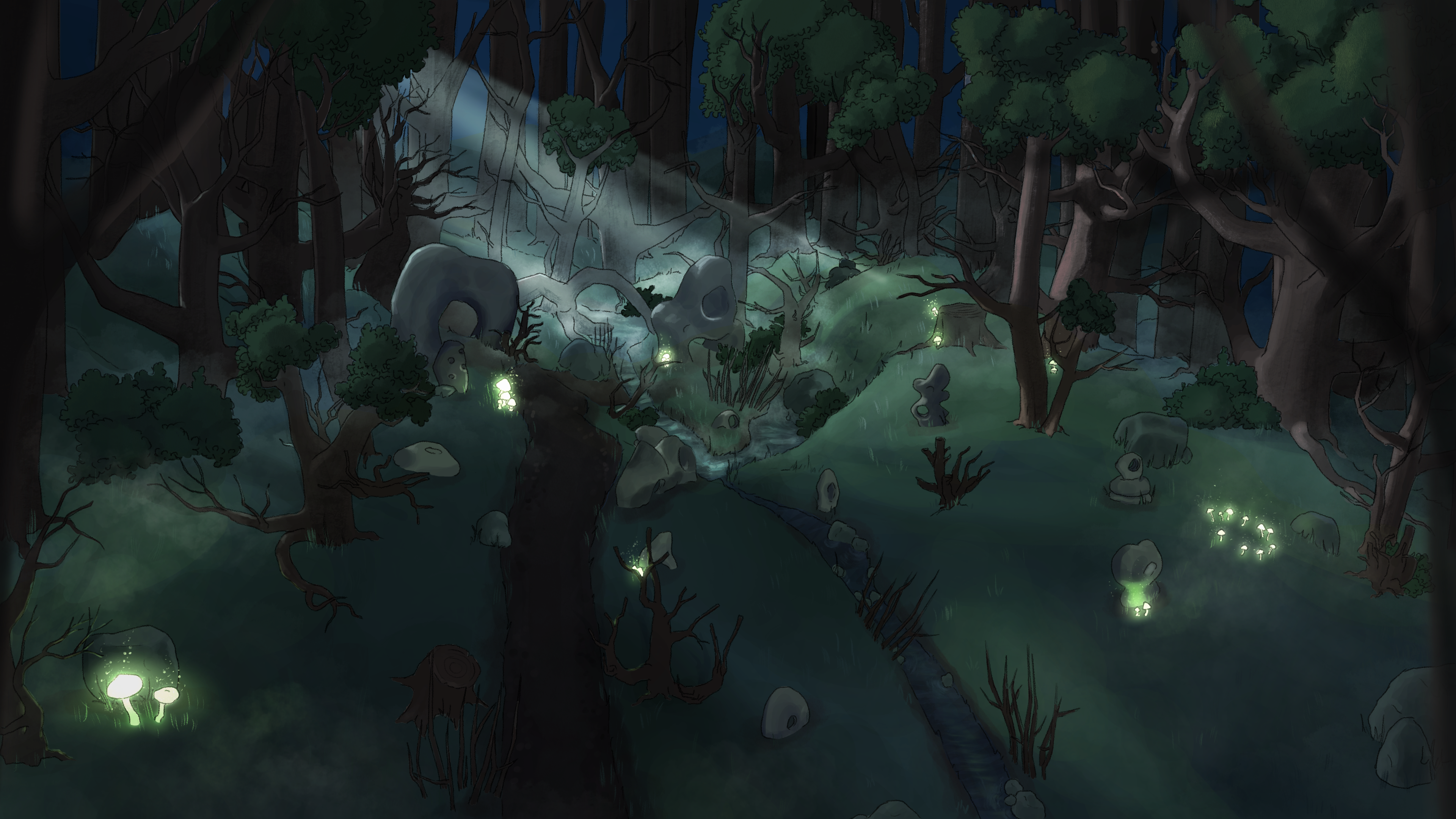
Figure 2. MCEWEN, Kirsty. 2014. The Vanishing of Ethan Carter Photograph: Nordic Games. The Guardian [online]. https://www.theguardian.com/technology/2014/oct/07/the-vanishing-of-ethan-carter-review-a-spell-binding-sinister-mystery [Accessed on: 25/04/2023]

Figure 3. SPENCE, Nel. 2023. Rough Sketches. Private Collection: Nel Spence

Figure 4. SPENCE, Nel. 2023. GAM703 Mural Board. Private Collection: Nel Spence

GART704 - Final Paintings and Video

Day Scene
 
Night Scene


Submission Video

Week 26 - Reflective Journal

This week, I finished my final paintings, adding smaller details, fog, and texture.

Fig. 1: Spence, 2023. Adding Detail.

Fig. 2: Spence, 2023. Final Day Scene Painting.

Fig. 3: Spence, 2023. Night Scene Lineart.

Fig. 4: Spence, 2023. Night Scene Grayscale.

Fig. 5: Spence, 2023. Night Scene Colours.

Fig. 6: Spence, 2023. Final Night Scene Painting.

References:

Images:

Figure 1. SPENCE, Nel. 2023. Adding Detail. Private Collection: Nel Spence

Figure 2. SPENCE, Nel. 2023. Final Day Scene Painting. Private Collection: Nel Spence

Figure 3. SPENCE, Nel. 2023. Night Scene Lineart. Private Collection: Nel Spence

Figure 4. SPENCE, Nel. 2023. Night Scene Grayscale. Private Collection: Nel Spence

Figure 5. SPENCE, Nel. 2023. Night Scene Colours. Private Collection: Nel Spence

Figure 6. SPENCE, Nel. 2023. Final Night Scene Painting. Private Collection: Nel Spence

Week 25 - Reflective Journal

This week I focused on starting to paint over screenshots of my scene, to create the final concepts and lighting set ups. 

Fig. 1: Spence, 2023. Paint Over - Lines.

Fig. 2: Spence, 2023. Paint Over - Gradients.

Fig. 3: Spence, 2023. Paint Over - Colours.

I've also been working on my final video, taking some short renders of my scenes in Maya. I was surprised to find in my night scene that rendering 2.5 seconds worth of footage at 24fps, in 720p, was taking up to four hours due to the number of lights. Below are screenshots of the number of lights in my night scene (fig. 4), compared to my day scene (fig. 5).

Fig. 4: Spence, 2023. Night Scene Lights.

Fig. 5: Spence, 2023. Day Scene Lights.

The bulk of the lights in my night scene are on the mushrooms, which are mesh lights, but also have point lights for added glow. The directional lights are adding more colour to the scene (without shadow), with one later being removed and replaced with a spotlight to immitate "god rays" from the moonlight.

Fig. 6: Spence, 2023. Day Scene Video Screenshot.

Fig. 7: Spence, 2023. Night Scene Video Screenshot.

Overall, I think my scenes have come together quite well, and I'll hopefully get some good footage for the final video.


References:

Images:

Figure 1. SPENCE, Nel. 2023. Paint Over - Lines. Private Collection: Nel Spence.

Figure 2. SPENCE, Nel. 2023. Paint Over - Gradients. Private Collection: Nel Spence.

Figure 3. SPENCE, Nel. 2023. Paint Over - Colours. Private Collection: Nel Spence.

Figure 4. SPENCE, Nel. 2023. Night Scene Lights. Private Collection: Nel Spence.

Figure 5. SPENCE, Nel. 2023. Day Scene Lights. Private Collection: Nel Spence.

Figure 6. SPENCE, Nel. 2023. Day Scene Video ScreenshotPrivate Collection: Nel Spence.

Figure 7. SPENCE, Nel. 2023. Night Scene Video ScreenshotPrivate Collection: Nel Spence.

Week 24 - Reflective Journal

This week I continued lighting tests in Maya, as well as filling out my scenes with more foliage and adding sky dome lights. I have the option to add images to the sky dome, but may look into painting my own colour gradient instead.

Seeing how the glowing mushrooms worked in the scene helped me determine where to add more. For the night scene, each mushroom has a mesh light to match, as well as point lights to add more glow and help reflect the green off nearby objects. 

I also threw in a plane as a placeholder for water, and may look into using a different materal to help imitate the way light would reflect.

Fig. 1: Spence, 2023. Night Scene Render

Looking at my day scene (fig. 2), it was looking too blue, leaning towards early morning or dusk. I played with intensifying the orange/yellow directional light, before adding a pink directional light to imitate the colours in my paint over from my previous post (fig. 3).

Fig. 2: Spence, 2023. Day Scene Render

Fig. 3: Spence, 2023. Day Scene Render with Pink Light

The pink light added more warmth and improved the scene's overall lighting.

As seen in fig.1 and fig.2, I tried adding a sphere with mesh light in to act as a moon, but found it troublesome to work out, as for some reason it behaved differently to the mesh lights I'd applied to the mushrooms. The light would stay visible in the day scene (fig.2), despite being on the hidden layer with the rest of the night lights, and the mesh light would have no effect, regardless of intensity or exposure. If time allows, I may work through more tutorials to make this work in my night scene renders.

Fig. 4: Spence, 2023. Fog Tests in Maya

I briefly experimented with adding fog to my scene, which I like the look and atmosphere of. I would like to use fog in my final renders and painting, so will do more work into experimenting with it.

Another reason to add fog would be to improve the lighting and not have the entire scene be too dark, the same reason for which I have a blue sky dome and not black. In films such as Mad Max: Fury Road (2015), the night scenes have a blue overlay (fig.5), as these scenes were filmed during daylight in order to maintain good lighting, then made to appear as night time in editting. 

Fig. 5: Buchanan, 2020. Mad Max: Fury Road Night Scene

Other night scenes in films like Harry Potter and the Philosopher's Stone (2001) and Ghost (1990). The scene in fig.6 from Harry Potter uses a blue tint, as well as fog which reflects what is supposedly moonlight. The lamp also creates a "hard" light, that brightly lights subjects close to it, but diffuses on subjects further away, creating the illusion of surrounding darkness -- this is a technique I'm attempting to replicate in my own night scene with the glowing mushrooms.

In Ghost, outdoor night scenes are seemingly always wet, as the moisture reflects light, adding more contrast and bounce light. 

Fig. 6: Paar, 2018. Harry Potter Night Scene

I followed some YouTube tutorials by Academic Phoenix Plus on adding fog to Arnold renders. Using the aiAtmosphereVolume and a spotlight, I tested lighting a plane and cube, changing the cone size of the spotlight, harshness of the edges, etc.

Fig. 7: Spence, 2023. Fog + Spotlight Test

Fig. 8: Spence, 2023. Fog + Spotlight Test (2)

After these tests I applied the fog to my night scene, and added a spotlight in to imitate moonlight with some minor "god rays".

Fig. 9: Spence, 2023. Fog in Night Scene

Fig. 10: Spence, 2023. Adding Spotlight and Trees

For the day scene, I started by filling out the scene background more and changing the lighting slightly - mainly small changes in intensity and changing the skydome colour to have a more purple tone.

Fig. 11: Spence, 2023. Filling Day Scene

I also changed the water texture to a blinn, that reflected parts of the scene near the water. Adding an intense spotlight imitated an offscreen sunset, and putting fog in the distant trees created an idea of approaching darkness/nightfall.

Fig. 12: Spence, 2023. Sunset Light and Fog

I also changed the depth of field in both day and night scenes and tried to keep a middle area of focus to draw the eye.

Fig. 13: Spence, 2023. Night Scene with DOF

Fig. 14: Spence, 2023. Night Scene Comparison with Early Render

Next week my plan to draft camera movement in my scenes and make headway with the paintings.


References:

Images:

Figure 1. SPENCE, Nel. Night Scene RenderPrivate Collection: Nel Spence

Figure 2. SPENCE, Nel. Day Scene RenderPrivate Collection: Nel Spence

Figure 3. SPENCE, Nel. Day Scene Render with Pink LightPrivate Collection: Nel Spence

Figure 4. SPENCE, Nel. Fog Tests in Maya. Private Collection: Nel Spence

Figure 5. BUCHANAN, Kyle. 2020. Mad Max: Fury Road Night Scene. The New York Times [online]. Available at: https://www.nytimes.com/2020/05/12/movies/mad-max-fury-road-oral-history.html [Accessed on: 01/03/2023]

Figure 6. PAAR, Morgan. 2018. Harry Potter Night Scene. Videomaker [online]. Available at: https://www.videomaker.com/light-the-night-how-to-light-a-realistic-night-scene/ [Accessed on: 28/02/2023]

Figure 7. SPENCE, Nel. Fog + Spotlight TestPrivate Collection: Nel Spence

Figure 8. SPENCE, Nel. Fog + Spotlight Test (2)Private Collection: Nel Spence

Figure 9. SPENCE, Nel. Fog in Night ScenePrivate Collection: Nel Spence

Figure 10. SPENCE, Nel. Adding Spotlight and TreesPrivate Collection: Nel Spence

Figure 11. SPENCE, Nel. Filling Day ScenePrivate Collection: Nel Spence

Figure 12. SPENCE, Nel. Sunset Light and FogPrivate Collection: Nel Spence

Figure 13. SPENCE, Nel. Night Scene with DOFPrivate Collection: Nel Spence

Figure 14. SPENCE, Nel. Night Scene Comparison with Early Render. Private Collection: Nel Spence

Week 36+37 - Reflective Journal - GAM705

 We are now onto our major project, and final module. The year is coming to an end, and my aim is now to create work to add to my portfolio ...